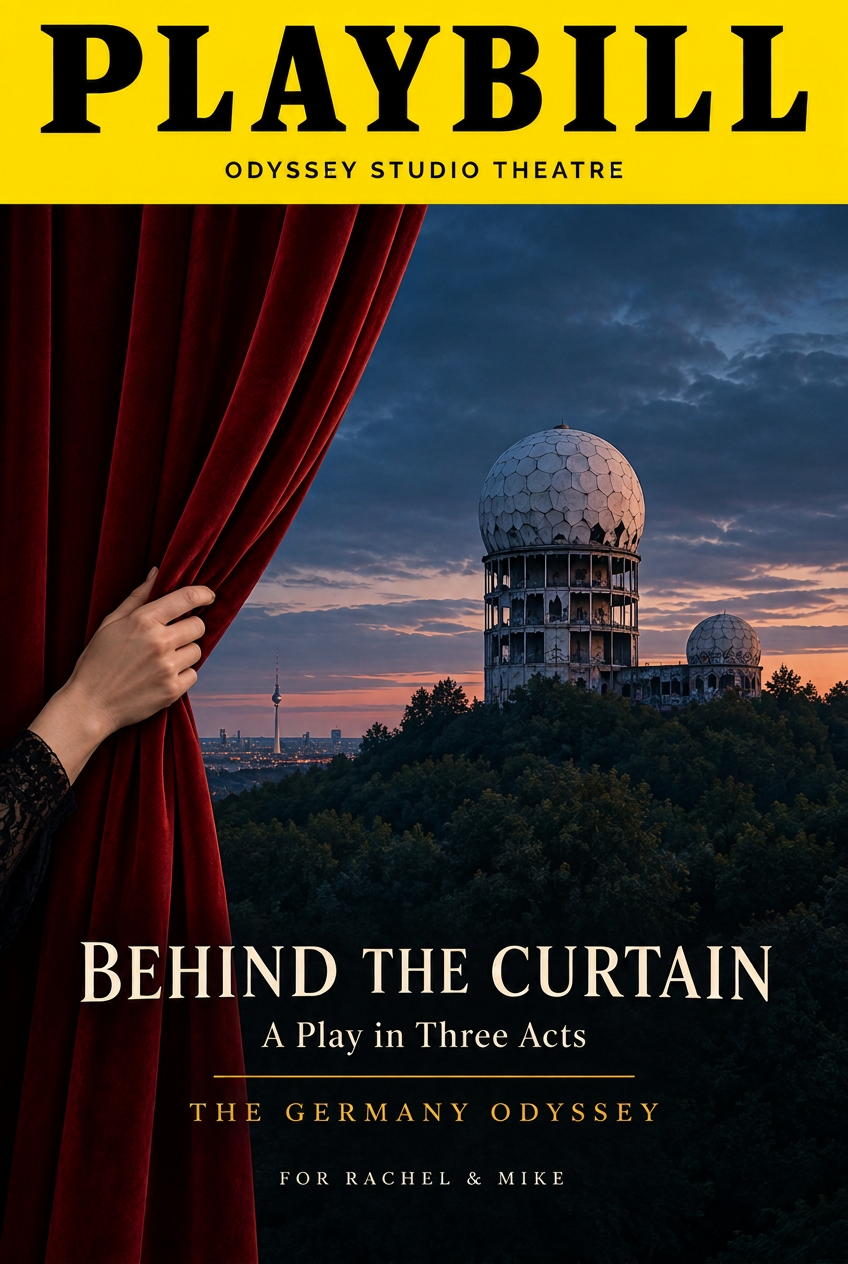
Playbill — Odyssey Studio Theatre. Behind the Curtain, A Play in Three Acts, The Germany Odyssey for Rachel and Mike

A note from the playwright

Every journey begins with a question.

Sometimes you know the question when you leave.

Sometimes you only discover it along the way.

This one begins with machines, mountains, borders and stages — with the things people build, the things they hide, and the things they make visible.

Somewhere along the way, the curtain moves.

Look behind it.

Lori

The itinerary

Ten Days in Germany

Machines, mountains, borders and stages—and the stories revealed when you look closer.

  1. 01The House Lights DimFrankfurt → Heidelberg · Act I · The Machine
  2. 02Two Skies, One RaceSpeyer · Sinsheim · Act I · The Machine
  3. 03Into the HarzHeidelberg → Wernigerode · Act II · The Mountain
  4. 04Inside the MachineWernigerode · Brocken · Act II · The Mountain
  5. 05The First CurtainWernigerode → Berlin · Act III · The Stage
  6. 06Behind the WallBerlin · Act III · The Stage
  7. 07The Wall, on Two WheelsBerlin · Act III · The Stage
  8. 08Behind the CurtainBerlin · Act III · The Stage
  9. 09The Final SceneBerlin — or beyond · Choose Your Own Ending
  10. 10Curtain CallDepart · Curtain Call

Scene One

The Eighth Wonder

CAMERA zooms in on the page of a play.

ECU: CAST OF CHARACTERS:

Prince Frederick V of HeidelbergAlan Smithee

Princess Elizabeth StuartRachel Spitzig

Salomon de Caus, French engineerMike Runde

DISSOLVE TO:

EXT. HEIDELBERG CASTLE – HORTUS PALATINUS GARDEN – DAY – 1614

SALOMON DE CAUS secures a water jet embedded in a rock outcropping.

He barely registers the arrival of PRINCE FREDERICK V, who strides toward him.

FREDERICK V

My dear man, you are sure you will have this completed on schedule?

De Caus is so intent on his work that it takes him a moment to realize he has been addressed.

DE CAUS

Hm? Oh. I wouldn’t stake my life on it.

A beat.

DE CAUS (CONT’D)

But I endeavor to do so.

FREDERICK V

My new bride must know Heidelberg is worthy of her.

Frederick looks around at the unfinished terraces.

FREDERICK V (CONT’D)

Do not let me down.

Frederick huffs off.

De Caus watches him go for half a second.

Then returns to the water jet.

A hiss.

The jet suddenly leaps higher.

De Caus smiles.

And then he notices someone watching him.

PRINCESS ELIZABETH saunters toward him.

ELIZABETH

My.

She takes in the terraces.

ELIZABETH (CONT’D)

All this effort. All this artistry.

She looks toward the castle.

ELIZABETH (CONT’D)

They say it may be the Eighth Wonder of the World.

A beat.

ELIZABETH (CONT’D)

You are quite the talk of town.

For perhaps the first time all day, De Caus is caught off guard.

He blushes.

DE CAUS

M’lady.

He gestures toward the garden.

DE CAUS (CONT’D)

Allow me to present my latest additions.

He leads her toward a cluster of sculpted figures.

DE CAUS (CONT’D)

Over here, the mechanical birds will sing.

A hidden mechanism activates.

A bird chirps.

Elizabeth smiles.

DE CAUS (CONT’D)

And over there—

He points toward the statue.

DE CAUS (CONT’D)

—Memnon. He moves and makes sound depending upon the warmth of the sun.

Elizabeth looks from the statue to De Caus.

ELIZABETH

The sun makes him sing?

DE CAUS

Among other things.

He gestures toward the waterworks.

DE CAUS (CONT’D)

Shifting pressure. Hidden chambers. Water where you don’t expect it.

Elizabeth looks around.

The garden is suddenly alive with movement and sound.

ELIZABETH

You really are a wonder.

De Caus looks at her.

ELIZABETH (CONT’D)

Never have I seen such a combination of movement, sound, sculpture --

She looks toward the terraces.

ELIZABETH (CONT’D)

— and nature.

A beat.

Perhaps a flicker between them.

FADE OUT
Act I

The Machine

Heidelberg · Speyer · Sinsheim

The Old Bridge and the Neckar, with the castle rising above Heidelberg's old town — where the journey begins.Photo: Hiroki Ogawa, CC BY 3.0, via Wikimedia Commons

01

Day 01

Frankfurt → Heidelberg

The House Lights Dim

A river town, an old bridge, and the first quiet hush before the play begins.

MoveFrankfurt → Heidelberg
SleepHeidelberg
PaceArrival and ease

Arrival

  • Land in Frankfurt, then leave the airport behind. The journey begins in Heidelberg.

Evening

  • Settle in, then wander Heidelberg’s old town at your own pace — the river, the old bridge, the castle above it — before dinner.

Buran OK-GLI, ferried up the Rhine toward Speyer — a Soviet space-shuttle test vehicle built for the Cold War race into space.Photo: Eckhard Henkel, CC BY-SA 3.0 DE, via Wikimedia Commons

02

Day 02

Speyer · Sinsheim

Two Skies, One Race

East and West. Two answers to the same impossible question: how do you get there first?

MoveTrain · private car · train
SleepHeidelberg
PaceFull, with room to linger

Morning — Speyer

  • Stand beneath Buran, the Soviet space-shuttle test vehicle — a machine born from the Cold War race into space. ↗

Afternoon — Sinsheim

  • Then change the question from space to speed.

  • At Technik Museum Sinsheim, Concorde and Tu-144 stand side by side: the British-French and Soviet answers to supersonic passenger flight. And unlike most museum aircraft, you can go inside both.

Evening

  • Return to Heidelberg. Dinner and the evening are yours.

Scene Two

Herr Urian

PUSH IN on a play’s Cast of Characters.

CAST OF CHARACTERS:

ActressRachel Spitzig

Werner Vesterling, ElectricianMike Runde

Major Manfred SchulzJohn Smith

Border Guard 1John Doe

Border Guard 2John Smithdoe

Woman In CrowdJane Doe

PULL BACK TO:

EXT. BROCKEN SUMMIT – THE GATE – DAY

SUPER: DECEMBER 3, 1989

A CROWD gathers at the gate. There is CHANTING.

BORDER GUARD 1 looks nervously at BORDER GUARD 2.

BORDER GUARD 1

Do you know what they are saying?

BORDER GUARD 2 shakes his head.

One voice grows louder.

ACTRESS

The witches ride to the Brocken's top, The stubble is yellow, and green the crop. There gathers the crowd for carnival: Sir Urian sits over all.

The crowd repeat from her last line: HERR URIAN, HERR URIAN …

A puzzled electrician asks the woman standing next to him.

ELECTRICIAN

Do you know what they chant?

WOMAN IN CROWD

yeah – Goethe. From Faust. Say – is it true you organized all this?

He SMILES as he writes a number on a paper. He slips his hand through the gate and passes the note to Border Guard 1.

Border Guard 1 reads it and jogs back to the guard booth. Makes a call.

INT. BROCKEN SUMMIT COMMAND POST – DAY

MAJOR MANFRED SCHULZ puts the phone down.

MAJOR MANFRED SCHULZ

(sotto)

We’re outnumbered.

He looks toward the window. The chanting grows louder.

A beat.

MAJOR MANFRED SCHULZ (CONT’D)

Hell, the Wall is down.

He picks up the phone.

MAJOR SCHULZ (CONT’D)

Open the gate.

EXT. BROCKEN SUMMIT – THE GATE – DAY

The guards open the gate. The crowd look shocked. Some look at the Actress with admiration — at the way she has given the crowd a shared voice.

Others look at the organizer, an electrician who knew whom to call, with gratitude.

The actress and electrician look at each other and smile.

FADE OUT

Act II

The Mountain

Wernigerode · Harz · Brocken

Wernigerode Castle after sunset — lights on in the valley, the fairy tale settling into the Harz. The whole act, in one frame.Photo: GZagatta, CC BY-SA 4.0, via Wikimedia Commons

03

Day 03

Heidelberg → Wernigerode

Into the Harz

Leave the Rhine behind. The landscape changes, the towns change, and suddenly the castle is real.

MoveHeidelberg → Wernigerode
SleepWernigerode
PaceA travel day, gently

Day

  • Travel north into the Harz Mountains and settle into Wernigerode, a town of half-timbered houses gathered beneath its castle.

Afternoon — Wernigerode Castle

  • Wernigerode Castle, a real-life storybook castle overlooking the Harz. ↗

  • Then come back down and simply wander.

Evening

  • Dinner in the old town. No agenda.

The Brockenbahn at Drei Annen Hohne — narrow-gauge steam, still climbing the mountain the Stasi once listened from.Photo: W. Bulach, CC BY-SA 4.0, via Wikimedia Commons

04

Day 04

Wernigerode · Brocken

Inside the Machine

Steam, iron, and a mountain that once listened to everything.

MoveHarz narrow-gauge railway
SleepWernigerode
PaceFull · Immersive

Morning — Wernigerode Locomotive Yard

  • Begin with the preparation of the steam locomotive, then climb aboard one of the working locomotives and ride in the cab as it climbs toward the Brocken. ↗

  • This isn’t a heritage train ride from the outside.

  • You’re inside the machine.

Midday — Brocken

  • At the summit, walk to the Brockenhaus, the former East German listening station whose location made this mountain one of the most closely watched places in the Cold War. ↗

  • Then take your time on the summit before returning to Wernigerode by passenger car.

Evening

  • Wernigerode. Dinner and a quiet night.

Intermission

House Lights Come Up

Choose your pause.

Henne

The Wall Was Five Meters Away

An old Berlin tavern in Kreuzberg, opened in 1908, where the Berlin Wall once ran just five meters from the door. Sit at the bar, have a drink, and absorb a place that was simply there while the city was divided.

Henne

Sphere Bar

Berlin From 203 Meters Up

Rise above Alexanderplatz for a drink inside the Fernsehturm, the iconic television tower built in 1969 as a symbol of East Berlin. At 203 meters, the Sphere Bar gives you a 360-degree view over the city — including the landscape of the former divided Berlin.

Sphere Bar at the Berlin TV Tower

Scene Three

The Other Side

PUSH IN on Cast of Characters:

Tom Maguire, U.S. Army, Intercept SpecialistMike Runde

Jason Potter, U.S. Army Security AgencyDieter Knaup

Robert OppenheimerEkkehard Schall

Stage Manager, Berliner EnsembleRachel Spitzig

RACK FOCUS: A hand grips the curtain.

The hand pulls it back.

INT. BERLINER ENSEMBLE — WINGS — NIGHT

SUPER: APRIL 12, 1965

STAGE MANAGER stands in the wings with a prompt script in one hand.

The script shows:

IN DER SACHE J. ROBERT OPPENHEIMER A scenic report / documentary play by Heinar Kipphardt Berliner Ensemble — 1965 production Directed by Manfred Wekwerth and Joachim Tenschert

She watches the scene.

OPPENHEIMER

That a man should be destroyed because of his present or past views — I disapprove of that.

STAGE MANAGER makes a small notation in the margin.

STAGE MANAGER

Stand by lights ….

A beat.

STAGE MANAGER

Go.

The light changes.

CUT TO:

INT. FIELD STATION BERLIN — TEUFELSBERG — NIGHT

A windowless room.

Banks of equipment. Paper. Headphones. Cigarette smoke.

TOM MAGUIRE sits at his station.

Beside him, JASON POTTER, newly arrived, listens.

A low hiss.

Russian voices.

Potter writes something down.

Maguire raises a hand.

MAGUIRE

Wait.

Potter stops.

They listen.

A voice comes through again.

Maguire leans closer.

MAGUIRE

Artillery.

Potter looks at him.

Maguire takes the paper and makes a correction.

MAGUIRE

Don’t translate what you think you heard.

A beat.

MAGUIRE

Translate what you heard.

CUT TO:

INT. BERLINER ENSEMBLE — WINGS — NIGHT

STAGE MANAGER is poised to call the next cue.

OPPENHEIMER (V.O.)

At this crossroads, we physicists feel that we have never had so much importance and that we have never been so powerless.

CUT TO:

INT. FIELD STATION BERLIN — NIGHT — 1965

Maguire sits at the listening station.

Headphones on.

STATIC.

A Russian voice emerges.

Maguire listens.

His pencil stops.

He looks up.

MAGUIRE

I heard it.

CUT TO BLACK.

Act III

The Stage

Berlin

The Berliner Dom and the Museum Island colonnade at golden hour — the Spree holding the last of the light as the final act begins.Photo: abbilder, CC BY 2.0, via Wikimedia Commons

05

Day 05

Wernigerode → Berlin

The First Curtain

Leave the mountains behind. The next act begins in Berlin.

MoveTrain or private car
SleepBerlin
PaceArrive · settle in · first theater

Day

  • The Harz gives way to Berlin—a city of walls and revolutions, ruins and reinventions, stages and secrets.

  • Arrive at your new Berlin home base and settle in.

  • Then begin the city’s theater story.

Evening — Berliner Ensemble

  • Your first encounter is with one of Berlin’s legendary stages: the Berliner Ensemble, the theater founded by Bertolt Brecht and Helene Weigel. ↗

  • The lights go down. The curtain rises.

  • And this is only the beginning.

  • Your Berlin dates may fall during Theatertreffen, Berlin’s annual festival of ten jury-selected productions from across the German-speaking theater world. The festival unfolds throughout the day and evening, so the following days remain intentionally flexible around its program.

06

Day 06

Berlin

Behind the Wall

The city as it was lived—from the inside.

MovePrivate guide · Berlin
SleepBerlin
PaceThoughtful · immersive

Day

  • Spend the day with a private East Berlin guide who can take you beyond the monuments and into the lived experience of the GDR.

  • See Berlin through the eyes of someone who knows the city from both sides of the Wall—its streets, its surveillance, its contradictions, and the extraordinary changes that followed 1989.

  • Visit Hohenschönhausen, the former Stasi prison, then go below the city for one strong Cold War experience with Berliner Unterwelten.

  • The point isn’t to collect Cold War sites.

  • It’s to understand the city that lived through them.

Evening — Berlin, at your pace

  • Theatertreffen may take the evening.

  • A selected production could become tonight’s curtain call, with most festival productions presented with English surtitles. Or leave the evening open to Berlin.

07

Day 07

Berlin

The Wall, on Two Wheels

See Berlin from the former border — and move through the city instead of simply looking at it.

MoveSmall-group bike tour
SleepBerlin
PaceActive · social · easy

Day

  • Today, you see Berlin from a different angle: on two wheels, following the former Wall through the city.

  • Join a small-group ride along a meaningful section of the Berlin Wall Trail, moving through places where the border once cut through neighborhoods, parks and railway lines.

  • Your guide brings the history to life as you ride — the Wall, the escape attempts, the places where it divided ordinary life.

  • Then get back on the bikes and keep moving.

  • The city is your route.

Afternoon / Evening — Theatertreffen

  • The festival isn’t confined to the theater after dark.

  • Audience discussions, jury talks, panels, readings and other accompanying events can make an afternoon or evening part of the Theatertreffen experience. Many of these events have simultaneous English interpretation, while selected readings offer English summaries.

  • The day’s theater choice can therefore be shaped around the program rather than added onto it. ↗

The Großer Windkanal at Adlershof — 1930s aerodynamics as concrete sculpture.Photo: Brücke-Osteuropa, Public domain, via Wikimedia Commons

08

Day 08

Berlin

Behind the Curtain

Where the machines were tested — and where the magic is made.

MoveSpecial access
SleepBerlin
PaceFull · flexible

Morning — Adlershof

  • Special access to Berlin’s historic Aerodynamic Park: the 1930s spin tower and historic wind tunnel, with whatever interior access can be secured. ↗

Theatertreffen — Afternoon / Evening

  • Keep this time open for the festival.

  • A selected production, audience discussion, jury conversation, panel or other public event may become the centerpiece of the day. English access makes it possible to engage with much more than the performances themselves. ↗

  • The program will shape the day.

Behind the Curtain — Berliner Ensemble

  • At another point in the Berlin stay, go behind the curtain at the theater you experienced from the audience on Day 5—on, behind and under the stage, with a look at the working spaces, costume and props departments. ↗

And beyond Theatertreffen

  • Berlin’s contemporary theater scene extends far beyond the festival. Depending on the program and what catches your attention, Maxim Gorki Theater, Sophiensæle, Volksbühne and HAU offer very different windows onto Berlin’s current theatrical life. English surtitles or English-language performances are available at each, depending on the production.

09

Day 09

Berlin — or beyond

The Final Scene

Every play ends differently, depending on who is watching.

MoveYour choice
SleepBerlin
PaceYours to decide

The runway that saved a city.

The Berlin Airlift, the vast former airport, and the extraordinary space the airfield has become today.

Open this ending

The final scene is yours to choose.

The Cube, from the Moltkebrücke — a glass box that is more than it seems. More on this in the Field Notes.Photo: Michielverbeek, CC BY 4.0, via Wikimedia Commons

10

Day 10

Depart

Curtain Call

The lights come up. The story goes home with you.

MoveTransfer
Sleep—
PaceDeparture

Departure

  • Depart Berlin.

Scene Four

Opposite Sides of the Curtain

INT. THE CUBE — BERLIN — DAY

RACHEL, Dramaturg, and MIKE, Director sit at a table with script pages, storyboards and shot lists STREWN about.

RACHEL

Do you think they’ll buy it?

MIKE

Buy what?

RACHEL

The two stories. Berlin. The theater. Teufelsberg. All of it.

MIKE

They’re happening at the same time.

RACHEL

That’s not a story.

MIKE

It’s history.

RACHEL

We’re not making a history book.

A beat.

MIKE

No. We’re making a movie.

RACHEL

A play.

MIKE

Whatever it is.

Rachel looks at the pages.

RACHEL

I still think people will ask why we never let them meet.

MIKE

They did meet.

RACHEL

When?

MIKE

In the story.

Rachel considers this.

RACHEL

That’s a very director answer.

MIKE

You’re the dramaturg. Fix it.

RACHEL

Maybe that’s what the story is.

MIKE

What?

RACHEL

Two people looking at the same thing from opposite sides of the curtain.

They share a smile.

CUT TO BLACK.

A beat.

THE END.

The inside track

Field Notes

The things worth knowing before you're standing there.

Heidelberg

The Garden That Became a Theater

In 1613, Frederick V brought the French engineer Salomon de Caus into his service. A year later, de Caus was commissioned to transform the terraces beneath Heidelberg Castle into a garden unlike anything Europe had seen.

The Hortus Palatinus combined landscape, sculpture and machinery: water-powered organs, moving figures, singing mechanical birds and fountains activated by hidden hydraulic systems. Visitors didn’t simply look at the garden. The garden performed.

Admirers called it the Eighth Wonder of the World.

De Caus also documented his experiments with steam and water in a book published in 1615. Centuries later, French writers would claim him as an early inventor of the steam engine—though the device he described was not a steam engine in the modern sense.

Today, the terraces remain. The machines do not.

Speyer & Sinsheim

Two Answers to the Future

The Cold War produced some wonderfully strange objects: machines designed not simply to work, but to prove that their side could do something first, faster or better.

Buran and the Space Shuttle emerged from different political and engineering systems but were built around the same extraordinary ambition: reusable spacecraft.

Then, on the ground, Concorde and the Tu-144 turned the race toward the future into something passengers could actually board.

Today, those competing visions sit quietly in German museums — close enough to compare.

Wernigerode & the Harz

And then there is the Brocken.

Wernigerode grew up around its castle and became an important town in the northern Harz, where timber, mining and forestry shaped the region for centuries. Its famous half-timbered houses give the old town much of its character today.

The Harz itself has a deeper industrial history. For centuries, its mountains were worked for silver, lead and other ores, leaving behind a landscape shaped as much by mining and engineering as by forests and medieval towns.

Tomorrow, you’ll go there by steam.

The Brocken

The Mountain That Listened

At 1,141 meters, the Brocken is the highest mountain in northern Germany. Its elevation and location near the former inner-German border made it strategically valuable during the Cold War.

The Brocken was not simply a mountain under surveillance. It was a listening machine. Two major signals-intelligence stations operated from the summit during the Cold War. The Soviet station was known as “Yenisei”; the Stasi station carried the code name “Urian.”

The summit was closed to ordinary East Germans and surrounded by military and security installations. Soviet and East German intelligence services operated listening equipment there, monitoring communications and military activity across the border and into West Germany.

The Brockenhaus occupies the former Stasi listening station. Today, its exhibits tell the story of the mountain’s military history and the people who lived and worked inside the restricted zone.

The railway is older than all of that. The Harz narrow-gauge network has been climbing into these mountains since the nineteenth century — and steam locomotives still do it today.

Berlin

A City Divided in Two

For twenty-eight years the Wall was not an abstraction. It ran through streets, gardens, windows and weddings — a border that turned neighbours into strangers and made one city into two arguments about how life should be lived.

East Berlin had its own rhythm: the tram you waited for, the flat you shared, the kitchen table where people said what they could not say anywhere else. The Stasi’s answer to that privacy was a file on almost everyone — and Hohenschönhausen is where the system kept the people it decided were enemies.

Beneath the city, the twentieth century never entirely left. Air-raid shelters, U-Bahn tunnels, abandoned stations and Cold War bunkers sit under the streets you walk today — a second Berlin that only shows itself when you go looking.

And then, in November 1989, all of it opened at once — not with a battle, but with people turning up at the barriers and asking to be let through. The city you spend a day inside is the one that lived through that.

The Wall Trail

The Wall, in Motion

The Berlin Wall was never just a line on a map. It cut through streets, neighborhoods, railway lines, cemeteries and gardens — sometimes following the most ordinary edges of the city.

After reunification, the physical barrier disappeared surprisingly quickly. What remains is a trail through a city that has absorbed a border that once seemed permanent.

Adlershof & the Stage

The Art of Making Things Move

Berlin’s history of invention isn’t confined to laboratories.

At Adlershof, aviation researchers experimented with the behavior of aircraft in flight. The surviving aerodynamic structures belong to a period when Berlin was becoming an important center for German aviation research—and when understanding airflow was still a remarkably physical problem: build something enormous, put it in motion, and see what happens.

The theater has its own version of the same obsession.

The Berliner Ensemble grew out of Bertolt Brecht’s theatrical experiments, but what happens onstage has always depended on an unseen world of scenery, lighting, rigging, mechanics and people. A theater is, in its own way, a machine for making imaginary worlds appear real.

Berlin’s Theater Ecology

What happens after Brecht?

Brecht helped make Berlin a place where theater could question its own rules. That spirit didn’t disappear with him.

Today, the city supports an unusually broad theatrical ecosystem: major repertory houses, experimental and intimate venues, international performance, new writing, dance, political theater and work that deliberately crosses the boundaries between them.

Theatertreffen sits within that ecosystem—but for a few weeks each year, it changes the scale of the conversation.

Ten productions. Seven critics. Hundreds of productions considered.

And the question isn’t simply What is the best?

The festival asks what is remarkable.

That might mean extraordinary craft. It might mean originality, risk, innovation—or the courage to attempt something that doesn’t quite work.

The result is a festival that doesn’t just present theater.

It gives Berlin a room in which to argue about what theater can be.

Berlin’s contemporary theater scene extends well beyond Theatertreffen. Major houses sit alongside intimate and experimental venues, with work ranging from new writing and political theater to international performance, dance and productions that cross disciplinary boundaries. Maxim Gorki Theater, Sophiensæle, Volksbühne and HAU offer very different windows onto that theatrical landscape. English surtitles or English-language performances are available depending on the production.

Theatertreffen

A Festival Born in a Divided City

Theatertreffen began in West Berlin in 1964, when the city was already divided by the Cold War.

Its original purpose was to bring together German-language theater and give theater communities separated by geography and politics a chance to see and compare one another’s work. During the Cold War, it became known as the “Showcase of the West.”

For years, invitations to East German theaters remained largely symbolic. Then, in May 1989, East German theater companies were finally able to travel to the festival—just six months before the Wall fell.

After reunification, the festival’s role changed again: from a showcase of the West to a showcase of German-language theater for the world.

The curtain has moved.

The festival remains.

The Cube

A Building That Thinks

From the Moltkebrücke, cube berlin looks almost impossibly simple: a glass box beside Berlin Hauptbahnhof, its faceted surfaces reflecting the station, the Spree and the city around it.

But the simplicity is an illusion.

Designed by Copenhagen-based 3XN and completed in 2020, cube berlin is a smart office building conceived as much as a technological system as a piece of architecture. Its 42.5-metre cube is wrapped in a fully glazed, double-skin façade whose angled elements create a constantly changing kaleidoscope of reflections. From one position, the building seems transparent; from another, opaque. The city appears inside the building, then disappears again.

Inside, the building has another layer of complexity. Thousands of sensors track conditions throughout the building, while a central digital “brain” coordinates systems including access, elevators, lighting, climate and energy. An app allows users to interact with the building and adjust the way they work within it. The architecture is designed to respond—to learn from how the people inside use it and adapt accordingly.

That makes the Cube an unexpectedly fitting final stop.

The journey has been asking what happens when you look closer: inside machines, behind borders, beneath the mountain, through the Wall, backstage at the theater.

Here, the building itself becomes the machine.

And the question changes.

What happens when the thing you are looking at is also looking back?

Where you sleep

Where the Story Sleeps

Even your hotel can become part of the story.
Choose your side of the Wall.

Villa Marstall on Lauerstraße, beside the Neckar at the edge of Heidelberg’s Old Town.Photo: Radosław Drożdżewski, CC BY-SA 4.0, via Wikimedia Commons

Act I · Two nights

Villa Marstall

A Villa Beside the River

A small historic hotel in a former 19th-century villa, right on the Neckar at the edge of Heidelberg’s Old Town.

The river is outside the door, the Old Bridge is a short walk away, and the castle rises across the water. It’s an easy place to arrive, put down your bags, and simply walk into Heidelberg.

Villa Marstall
Erbprinzenpalais at the foot of Wernigerode Castle.Photo: Migebert, CC BY-SA 4.0, via Wikimedia Commons

Act II · Two nights

Erbprinzenpalais

At the Foot of the Castle

A historic villa at the foot of Wernigerode Castle, with the old town below and the Harz rising beyond.

Stay in the historic villa, where rooms look toward the Brocken or the old town. After a day on the steam railway and the mountain, come back to a quiet corner of Wernigerode and let the day settle.

Erbprinzenpalais
Kantstraße 79 today — the former courthouse at the entrance to the Wilmina complex, with the former women’s prison behind it.Photo: Wilmina

Act III · Five nights

Wilmina

The Prison Becomes the Hideaway

Behind an unassuming gate on Kantstraße is a former courthouse and women’s prison, built in 1896 and closed in 1985. For almost three decades, the complex sat largely empty before architects Grüntuch Ernst began its transformation.

Today, the former cells are light-filled rooms. Original cell doors remain; barred windows were enlarged; sealed courtyards have become lush gardens. The architects’ aim was essentially to reverse the building’s original purpose — transforming a place of isolation into a place of encounter and retreat.

There is something wonderfully theatrical about arriving through the old prison entrance and discovering silence, gardens and light on the other side.

And the building has a history worth knowing: women involved with the resistance group Rote Kapelle were imprisoned here, as was writer Ulrike Edschmid during the student unrest of the 1960s. After its closure, the complex became an archive and occasional film location before reopening as Wilmina in 2022.

Where the story sleeps: Wilmina, Charlottenburg.

Wilmina
The 1902 swimming hall, restored and filled — the heart of Hotel Oderberger.Photo: Hotel Oderberger

Act III · Berlin option

Hotel Oderberger

A Swimming Pool with a Hotel Around It

A former 1902 public bathhouse in Prenzlauer Berg, restored with its original swimming hall still at the heart of the building.

The rooms are comfortable and understated, but the reason to stay here is the building itself—and the chance to swim in the historic pool where Berliners have been swimming for more than a century.

Hotel Oderberger
Inside Linnen — a room in the classic Berlin Altbau on Eberswalder Straße.Photo: Linnen

Act III · Berlin option

Linnen Hotel

Live Like a Local

A tiny, independently run boutique hotel in a classic Berlin Altbau on Eberswalder Straße, with high ceilings, original architectural details and individually designed rooms filled with vintage and upcycled pieces.

Just five minutes from Mauerpark and close to the cafés, galleries and everyday life of Prenzlauer Berg, Linnen is less about hotel polish than having a little piece of Berlin to come home to.

Linnen Hotel

Where to eat

A Few Tables Worth Knowing

A handful of names to keep in your pocket — nothing booked, nothing prescribed.

Heidelberg

  • Wirtshaus zum NepomukRegional food by the Old Bridge↗
  • SchnitzelbankOld wine tavern, communal tables↗
  • OBENOptional destination dinner above the city↗

Wernigerode

  • Ins kleine ParadiesHarz cooking in a cozy old-town setting↗
  • ZeitwerkOptional Michelin-starred deep dive↗

Berlin

If you choose Wilmina · Charlottenburg

You’re in a neighborhood with a strong food scene. A few places worth knowing:

  • LovisDinner inside Wilmina’s former prison↗
  • Good FriendsLong-running Cantonese favorite on Kantstraße↗

If you choose Oderberger or Linnen · Prenzlauer Berg

You’re in a different kind of Berlin neighborhood—lively, residential and packed with independent restaurants. A few places worth knowing:

  • ottoSeasonal, regional cooking and wine on Oderberger Straße↗
  • MaMi’s Food & WineA small neighborhood wine bistro with creative sharing plates↗
  • Zum SchusterjungenOld-school Berlin cooking in a traditional neighborhood restaurant↗

Before dates are set

The Fixed Points

The details that anchor the journey.

Frankfurt Airport → Heidelberg

  • There is a long-distance train station within the Frankfurt Airport complex, so there is no need to travel into Frankfurt first.

  • The journey to Heidelberg is approximately 50–60 minutes, usually with a connection at Mannheim; some services are direct.

  • From Heidelberg Hauptbahnhof, continue by taxi, tram or local transport depending on the hotel.

  • Heidelberg tourist information — hotels, tram routes, opening hours and what's on during your stay. ↗

Rail

  • DB Navigator or bahn.de can be used to research and purchase tickets in English. Station machines also offer English-language service and accept cards. ↗

  • Current fare reference: approximately €25–30 per person for a standard one-way journey, depending on train and fare type.

    This is a current planning reference, not a fare quote for the year you travel.

  • For an arrival day, a flexible fare may be worth considering if the flight schedule is uncertain rather than committing to a specific train.

Museum tickets

  • Tickets & visit planning — official Technik Museum ticketing. ↗

  • The same shop covers both museums, so you choose one site or the pass that admits you to Sinsheim and Speyer.

Morning · Heidelberg → Speyer

  • Travel by regional train from Heidelberg to Speyer.

  • From Speyer station, allow roughly 20 minutes on foot to the museum, or use local bus/taxi connections.

  • Technik Museum Speyer is currently open daily; allow approximately 2½–3 hours if Buran is the focus, with additional time if exploring the wider museum. ↗

  • Speyer Cathedral is immediately adjacent to the museum and can be added if you want it — it doesn't need to become a separate excursion. ↗

Speyer → Sinsheim

  • This is the one leg of the journey worth spending money on to protect the day.

  • The museums are roughly 40 km apart, about a 30-minute drive. Public transportation is substantially slower and routes back through Heidelberg, so a private car or taxi transfer is the sensible choice.

  • Current planning reference: approximately €100–140 for a private or taxi transfer, depending on vehicle and provider.

    This is a current frame of reference, not a quote for the year you travel.

Afternoon · Technik Museum Sinsheim

  • Technik Museum Sinsheim is immediately beside the Sinsheim Museum/Arena rail stop. ↗

  • Allow approximately 2½–3 hours for the museum.

  • Concorde and Tu-144 are both accessible from the museum complex, including their interiors.

  • Current museum admission is roughly €25–30 per adult as a planning reference. ↗

    Confirm pricing directly for the year you travel.

Sinsheim → Heidelberg

  • Return by train from Sinsheim Museum/Arena to Heidelberg.

  • Current journey time is roughly 40 minutes; the timetable for the year you travel is not yet available.

Heidelberg → Wernigerode

  • This is the longest rail movement of the core itinerary and should be treated as a travel day, rather than trying to schedule another major attraction en route.

  • Current rail routing requires connections; the exact timetable for the year you travel is not yet available.

  • Allow approximately 5–6+ hours, depending on the connection pattern selected.

  • A private car is possible but would make for a very long road journey; rail is the more natural choice.

  • Current fare reference: roughly €50–100+ per person, depending heavily on advance-purchase versus flexible fares and the specific routing.

    This is a planning frame, not a quote for the year you travel.

  • From Wernigerode station, the historic center is close enough to reach by taxi or local transport, depending on the hotel.

  • Wernigerode tourist information — hotels, walking routes, opening hours and what's on during your stay. ↗

Wernigerode Castle

  • Allow approximately 2–3 hours if you want to explore the castle interiors and grounds without rushing. ↗

    Confirm opening hours and admission directly for the year you travel.

HSB Dampf & Technik / Brocken

  • The Dampf & Technik im Nationalpark experience begins in Wernigerode with the preparation of the steam locomotive, followed by a Führerstandsmitfahrt—a cab/footplate ride aboard the working locomotive from Wernigerode to the Brocken. ↗

  • The current published program includes locomotive preparation in Wernigerode, the cab ride to the summit, time at the Brockenhaus, return to Wernigerode in a passenger car, and a visit to the HSB workshop.

  • The Brocken variant is the one to pursue for this journey: the locomotive itself becomes the experience, rather than simply riding as a passenger.

  • The current program is offered on request, on Fridays, subject to HSB availability. Communication during the experience is in German. ↗

  • Current planning reference: €259 per person.

  • The experience requires sturdy footwear and weather-appropriate clothing; there is no seating on the locomotive cab, and participants should expect exposure to vibration, soot, oil and emissions.

  • At the summit, Brockenhaus is a short walk from the railway station. The program allows time to explore the summit and visit the museum before returning to Wernigerode by passenger car. ↗

  • For the year you travel: confirm the operating date, availability, current pricing and English-language support directly with HSB before departure. HSB notes that the experience can be affected by locomotive availability even after a date has been confirmed. ↗

  • Weather at the summit can be dramatically different from Wernigerode below; visibility is not guaranteed.

Wernigerode → Berlin

  • Allow roughly 3–4 hours by rail, depending on routing and connections.

  • Schedules for the year you travel aren't available yet.

  • Current fare reference: roughly €50–100+ per person, depending on advance versus flexible fares and routing.

    This is a planning frame, not a quote for the year you travel.

  • Confirm the timetable for the year you travel and purchase tickets directly once booking opens.

Wilmina

  • Confirm check-in time and luggage storage if you arrive before the room is ready.

  • The hotel is in Charlottenburg; allow some local transfer time from the Berlin arrival station, depending on the rail routing. ↗

Berliner Ensemble · Day 5

  • Choose a production with English surtitles or an English-language performance. ↗

Hohenschönhausen

  • Former Stasi detention prison. Guided visits are central to the experience; select an English-language option. ↗

Berliner Unterwelten

  • Choose one Cold War-focused underground tour. English-language tours are available on selected dates. ↗

Private guides · Day 6

  • Matti Geyer — a highly personal, story-driven private guide with family roots in East Germany. ↗

  • Matthias Stukenbrok — grew up near the Wall and experienced the final years of East Berlin firsthand. ↗

  • Original Berlin Walks — book the East Berlin tour privately, with your own guide and the flexibility to shape the day around the questions you want to ask. The route explores everyday life in the GDR, the Wall, Stasi surveillance, escape stories and the fall of 1989, with room to go deeper rather than simply check off the landmarks. ↗

  • If what you're after is a person with lived or family experience rather than an excellent historian, Matthias or Matti is the stronger choice — Original Berlin Walks isn't naming a particular East Berlin-born guide at this stage.

Berlin on Bike — Berlin Wall & Cold War Tour

  • Berlin Wall & Cold War Tour — English-language small-group tour · approximately 3.5 hours · 12–15 km · bicycles and helmets included. ↗

  • Typical groups are around 8–12 riders, maximum 15.

  • 2026 planning reference: €35 including bike rental; e-bike supplement €20. Not a quote for the year you travel.

  • Reserve directly once your dates are set. Confirm the schedule, meeting point, current price and availability when booking.

Adlershof — Aerodynamic Park · Day 8

  • Historic 1930s aerodynamic research structures, including the Trudelturm (spin tower) and Großer Windkanal (large wind tunnel). The exteriors can be viewed independently; interior access requires a special opening/tour and should be arranged in advance. ↗

  • Access: Special/private arrangement via GBSL e.V.. ↗

  • Confirm access and available interior spaces before committing this as a fixed experience.

Berliner Ensemble — Backstage · Day 8

  • Arrange a private backstage visit rather than simply attending another performance. The goal is to see the theater from the working side of the curtain—stage, backstage spaces and theatrical infrastructure, subject to the theater’s availability and access rules. ↗

  • Important: Coordinate this around the theater's performance schedule and request English-language access.

Theatertreffen · Berlin

  • The festival runs each May ↗

  • Theatertreffen's program will determine the specific productions and events selected for the Berlin days.

  • The program is published in April, with ticketing information released as the festival schedule takes shape.

  • The program and ticketing information will shape the Berlin dates before departure.

  • Programming takes place throughout the day and evening

  • Most productions are presented with English surtitles

  • Specific productions and events selected once the program is released

  • The Berlin itinerary intentionally leaves flexibility around the festival schedule.

Planning note

  • Schedules and booking information for the year you travel may not yet be available. Journey times, routing and prices shown here are based on current information and are provided as planning guidance.

    Confirm schedules, fares, opening hours and admission prices directly once booking information for your travel year is available.